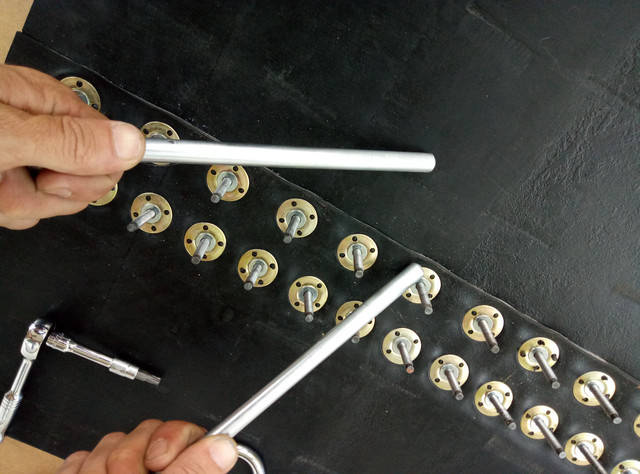
Range of application of R28 conveyor belt fasteners
Range of application of R28 conveyor belt fasteners is considerably wide, joints can be applied to all types of belts used in
mining. Joints as well as type of stitching have been developed mainly with a view to long strongly burdened conveyors. Stitching performed with a R28 conveyor belt fasteners successfully passed all the tests in many different mines. The
tests were conducted on the conveyors, belt joints of which hadn’t earlier stood the test while stitching performed with R28 conveyor belt fasteners have borne the test trouble-free. On the ground of tests conducted in the mines and tests carried out in laboratories on the strength machines using different variants of stitching there have been developed the most
advantageous methods of joint performance which give the highest parameters of endurance (ie belt end preparation for stitching, number of inserted joints, joint rows spacing).
The best strength results in the case of strongly burdened conveyors, are achieved by applying of 4 or more rows of joints. Proper belt end preparation for stitching is very important. Methods of belt end preparation and space between joints are shown in the exemplary pictures. In the pictures there shown a stitching for 5 and 7 rows of R28 conveyor belt fasteners, such stitching is recommended to use for 1000-4000 m long strongly burdened conveyor belts with the strength of 1600 – 2500 kN/m and more. But more rows of joints can be used, for example 10, if a user stated such a necessity. On average burdened 100-2000 m
long conveyors with the strength of 1000 – 1600 kN/m there can be used for example 5, 7 rows of joints and on 500
–1000 m long lightly burdened conveyors with the strength of 800 – 1000 kN/m 3, 4 rows are used.
Given solutions are recommended however final use depends on specific character of the
conveyor function as well as on the user who must take into consideration all factors responsible for conveyor function:
its length, burden (conveyor can work in the ramp).
The age of the belt is also important. When belt is new holes for joints should be made with Ø5,5 drill bit but when
the belt is already being used for several months with a Ø5,0 drill bit. Correct mounting prevents from appearing of so called hump in the place of stitching as well as shifts.
Note: it’s forbidden to apply glue in the place of joining.